Why Sirsi Road is Jaipur's Next Premium Real Estate Hub
A data-backed, no-fluff guide for buyers, investors, and NRIs evaluating Jaipur’s most undervalued western corridor — before the window closes.
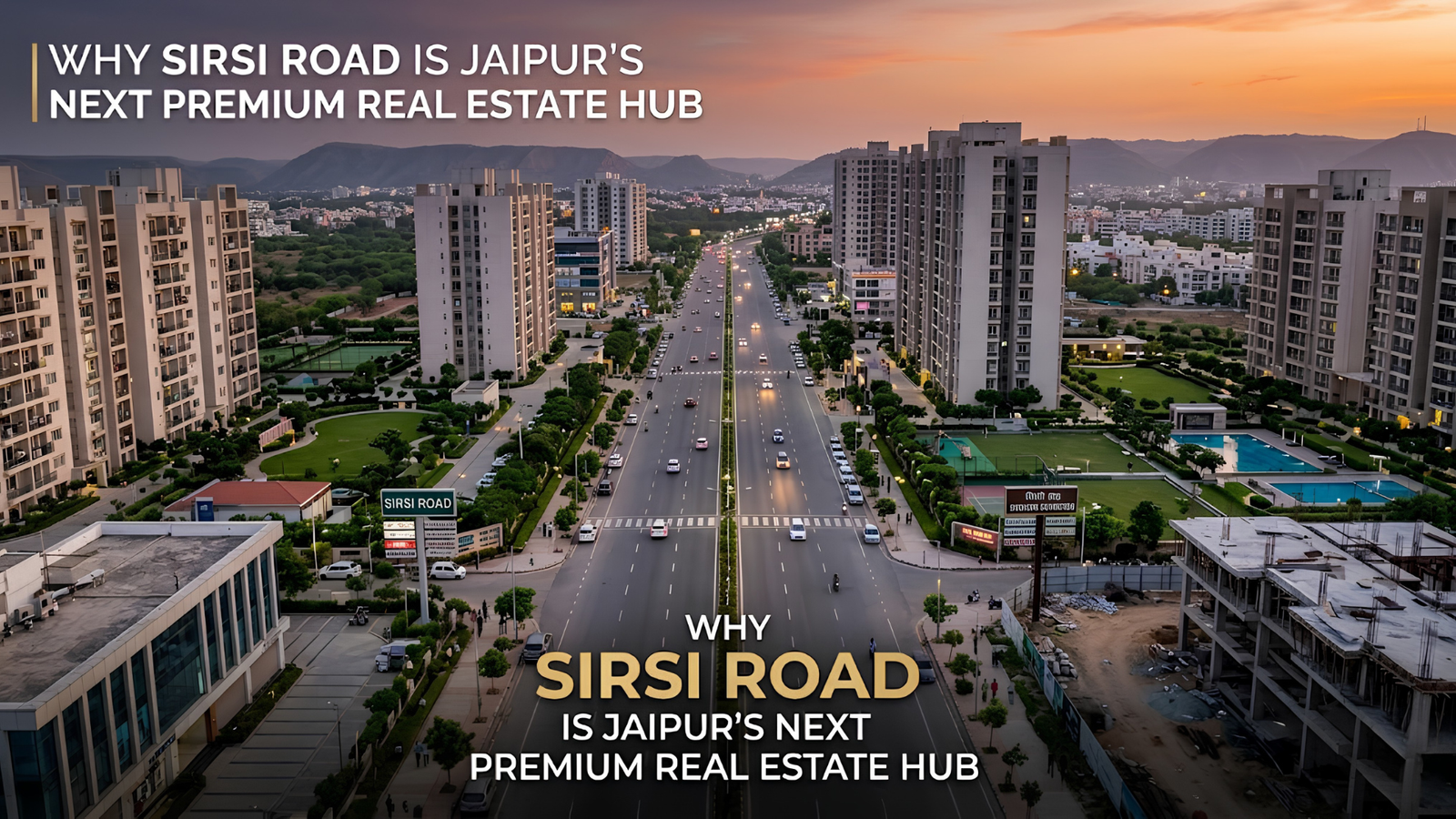
Table of Contents
Let’s get one thing straight before we go any further.
Every real estate article you’ve ever read about Jaipur has given you the same recycled list — Vaishali Nagar, Ajmer Road, Jagatpura, Tonk Road. The same corridors, the same commentary, the same advice. It’s not wrong. It’s just late.
The buyers who made real money on Vaishali Nagar got in when it was still ’emerging.’ The investors who doubled their capital on Jagatpura bought before the airport proximity became common knowledge. The pattern repeats itself in every city, in every market cycle, without exception.
Sirsi Road is where that pattern is playing out right now.
This isn’t a promotional claim. It’s a data observation. And by the time you finish reading this, you’ll have the numbers, the infrastructure timeline, the price history, and the buyer logic to decide for yourself whether this corridor deserves your attention — or whether you’d rather wait until everyone else figures it out first.
If you’re actively exploring flats in Sirsi Road Jaipur, this guide will help you understand not just where the market stands today, but where it’s heading next.
Quick snapshot: Average flat rate on Sirsi Road stands at ₹4,200/sq ft as of 2026. Land has appreciated 129.4% over 10 years and 85.7% in the last 3 years alone. The Northern Ring Road (₹6,500 crore) has broken ground. The Delhi-Mumbai Expressway spur to Jaipur is operational. And the corridor is still priced like nobody noticed.
Where Exactly Is Sirsi Road — And Why Does That Matter?
Sirsi Road runs through the northwestern fringe of Jaipur, falling under JDA Sector 3 (Vaishali Nagar / Hanuman Nagar / Sirsi Road zone) and Sector 13–14 (Khatipura / Sirsi Road / Khatipura Road zone), as well as the newer Sector 48–49 (Sirsi–Bindayaka area). The pin code is 302045 and neighbouring micro-areas include Panchyawala, Meena Wala, Kanakpura, and Bindayaka.
That address might not mean much to someone reading from Delhi or Mumbai. So here’s what actually matters:
Residential Buildings
- Jaipur International Airport: ~20 km via Tonk Road / Ring Road (approx. 35–40 min in normal traffic)
- Jaipur Junction (Railway Station): ~12 km via Khatipura Road
- Vaishali Nagar (prime residential): ~4–5 km — essentially next-door
- Mansarovar: ~6 km
- Civil Lines / C-Scheme (city centre): ~14 km
- RIICO Industrial Area (employment zone): 3 km — this is critical for rental demand
- Sitapura Industrial Zone: ~22 km via Ring Road
- NH-48 (Delhi-Mumbai Expressway corridor): ~3 km — a direct connectivity advantage almost no other mid-range corridor in Jaipur has
Road Connectivity
Sirsi Road connects to Khatipura Road on one end and extends outward toward Nimera, where the JDA Master Plan has identified a bus terminal node near the extended Sirsi Road. The corridor is linked to NH-52 (Jodhpur-Jaipur National Highway) and via that to NH-48 — Jaipur’s primary arterial connection to Delhi and the Delhi-Mumbai Expressway.
What this means practically: someone living on Sirsi Road can reach the Delhi-Mumbai Expressway entry point faster than someone living in Mansarovar or Ajmer Road. For an NRI or Delhi-NCR investor who intends to travel frequently, this is a non-trivial advantage.
What Residents Say
Sirsi Road is rated 4.1 out of 5 for connectivity and 4.2 out of 5 for safety by current residents on 99acres. It’s been specifically noted for good public transport options, easy cab availability, and proximity to markets and hospitals — the three things that actually drive daily liveability.
The honest trade-off: Sirsi Road currently has infrastructure gaps — water supply depends on private tankers in parts of the area, internal road quality is patchy in some colonies, and metro connectivity doesn’t exist yet. These are real issues. They are also exactly the issues that existed in Vaishali Nagar Extension five to seven years ago, before it transformed into one of the highest-rental-yield zones in the city.
The Numbers That Actually Matter — Price History on Sirsi Road
Most real estate content gives you a current rate and calls it research. That’s not research. That’s a listing. What tells you whether a corridor is worth investing in is the direction of travel — how prices have moved over time, and what that trajectory implies about the future.
Here is the full appreciation data for Sirsi Road, sourced from 99acres’ market trends (May 2026 data):
| Time Period | Flat Appreciation | Land Appreciation | Verdict |
|---|---|---|---|
| Last 1 year | 2.4% | 9.9% | Consolidation phase — land outpacing flats |
| Last 3 years | 40.0% | 85.7% | Strong mid-cycle growth across both asset types |
| Last 5 years | 64.7% | 95.0% | High capital gains for early investors |
| Last 10 years | 42.4% | 129.4% | Land has more than doubled — structural uptrend |
The numbers that stand out are the 3-year figures. Land up 85.7% in three years. Flats up 40% in three years. These aren’t anomalies — they reflect a fundamental shift in demand as the corridor crossed from ‘peripheral’ to ’emerging residential belt.’
Even more telling is the divergence between flat and land appreciation over 10 years. Flats are up 42.4% while land is up 129.4%. This tells you something important: the smart money that came in early wasn’t buying apartments. It was acquiring land, because land captures the full value of future development density. Apartments appreciate incrementally. Land appreciates exponentially when a corridor matures. That maturation cycle on Sirsi Road is still early.
How Does This Compare to Other Corridors?
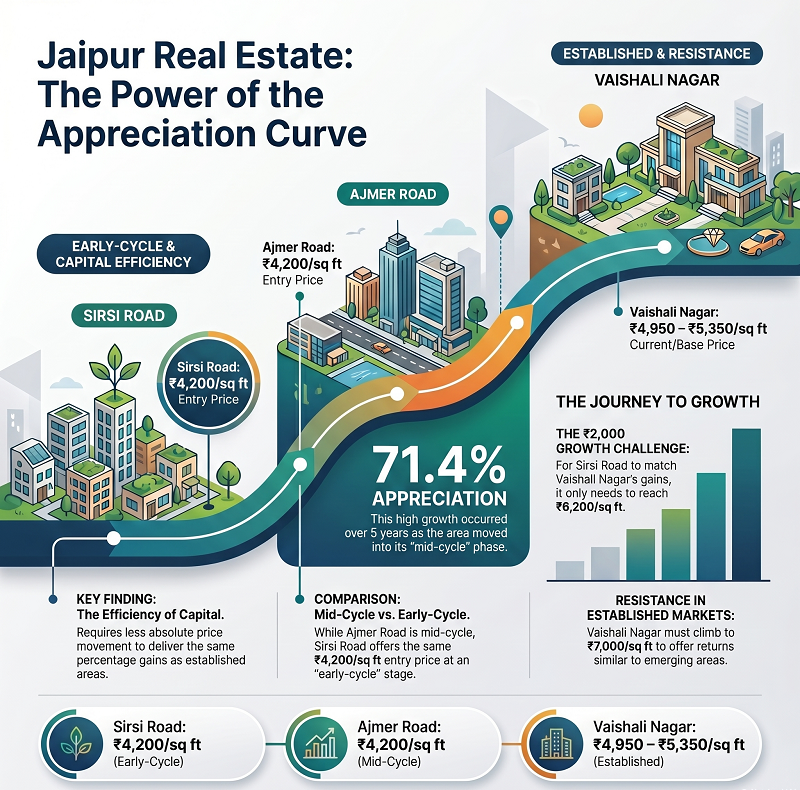
Ajmer Road’s flats have appreciated 71.4% in 5 years at the same base price of ₹4,200/sq ft. The difference is that Ajmer Road is mid-cycle and Sirsi Road is early-cycle. You’re entering at the same ticket size but at a different point on the appreciation curve. That’s the entire investment thesis in one sentence.
Vaishali Nagar has appreciated 41.4% in 5 years — but its current average rate is ₹4,950–5,350/sq ft. To earn a similar return from Vaishali Nagar going forward, it needs to run from ₹5,000 to ₹7,000. For Sirsi Road to deliver the same absolute gain, it only needs to run from ₹4,200 to ₹6,200. Which leg of that journey do you want to be on?
Why People Are Actually Buying Here — The Real Demand Drivers
Appreciation data tells you what has happened. Demand drivers tell you what will happen next. On Sirsi Road, several structural forces are converging simultaneously — which is unusual, and worth paying attention to.
Employment Proximity — The RIICO Anchor
RIICO Industrial Area is 3 km from Sirsi Road. This isn’t a minor detail. Industrial employment zones are the single most reliable driver of residential rental demand in Tier-1.5 Indian cities. Workers and mid-level executives who work in RIICO need housing within a practical commute radius. Sirsi Road sits in that radius. This creates floor demand — even in a slow market, the rental occupancy here doesn’t collapse because the employment anchor doesn’t move.
Schools and Education Infrastructure
Within 5–8 km of Sirsi Road you have Podar World School, City School of Jaipur, and Somani International School. The presence of reputed schools within proximity isn’t just a lifestyle amenity — it’s a buyer retention mechanism. Families with school-going children in these institutions will not relocate easily. This reduces turnover in the residential base, which supports consistent property valuations.
Healthcare Infrastructure
Marudhar Hospital and Global Heart & General Hospital are both within the Sirsi Road vicinity. Mahatma Gandhi Hospital is accessible from the corridor. For families making an end-use buying decision — not an investment decision — hospital proximity is frequently the deciding factor. It is a box Sirsi Road checks that many emerging corridors don’t.
Retail and Daily Convenience
Capital Galleria Mall, SP Tower, and Park Square are within the area’s retail catchment. For residents, this matters because daily convenience — grocery stores, pharmacies, retail services — determines quality of life and, by extension, rental desirability.
The Westward Expansion Story — This Is the Macro Force
Jaipur has been growing directionally westward for the last 15 years. The reason is structural: the old city to the east is dense, heritage-restricted, and priced out of reach for new residential development. The south (Tonk Road, Jagatpura) absorbed the first wave. The west — starting with Mansarovar, then Vaishali Nagar, then Vaishali Nagar Extension — absorbed the second wave.
Sirsi Road is the next node in this westward march. It has the land availability, the connectivity infrastructure, the employment proximity, and the price headroom that every previous wave corridor had before it got expensive.
Historical pattern: Mansarovar was priced at Sirsi Road’s current levels approximately 12–14 years ago. Vaishali Nagar was at these levels 7–9 years ago. Both corridors are now 25–40% more expensive. The buyers who benefited most were those who acted during the same early-cycle phase that Sirsi Road is in today.
The Infrastructure That Will Drive the Next 5 Years of Appreciation
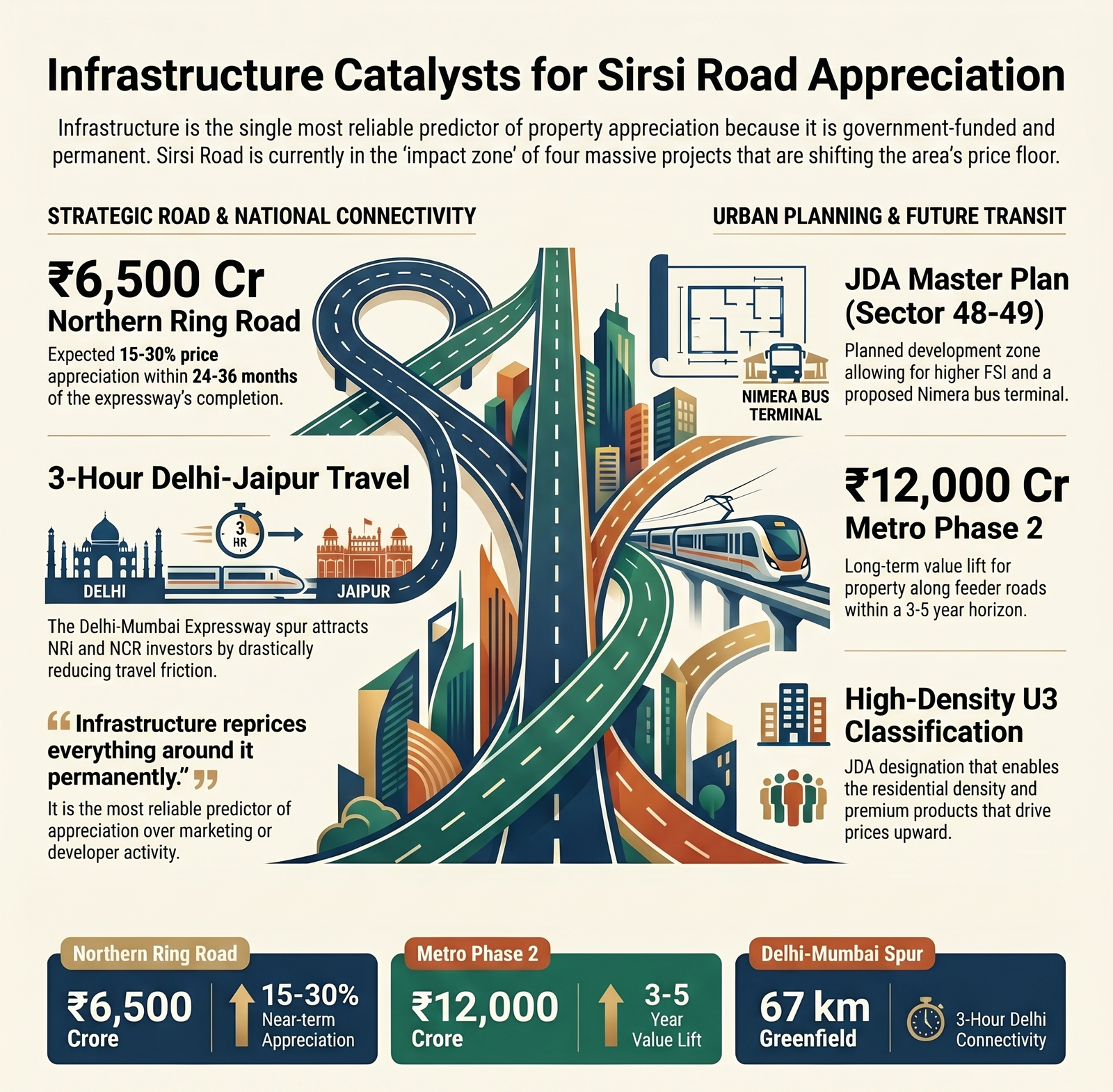
Infrastructure is the single most reliable predictor of property appreciation in emerging corridors. Not sentiment, not marketing, not developer activity. Infrastructure — because it is funded by governments, takes years to complete, and when it arrives, reprices everything around it permanently.
Sirsi Road sits in the impact zone of three separate infrastructure projects, all at different stages of completion. Here they are, specifically:
1. Northern Jaipur Ring Road — The Biggest Near-Term Catalyst
A 99.35 km six-lane access-controlled expressway is under development under NHAI’s Northern Ring Road project. The route runs from Chitroli on Ajmer Road to Bassi via Bagran, ending at Agra Road — effectively creating a bypass loop around northern Jaipur that directly elevates the connectivity of every corridor on its influence belt, including Sirsi Road.
Key facts: The project has an estimated investment of ₹6,500 crore. NHAI has initiated Section 3(A) notifications for land acquisition across 200 villages. The JDA is simultaneously developing 135-metre-wide development corridors on either side of the transport corridor for commercial expansion.
The price impact precedent is clear: across similar ring road projects in India, property prices in the direct influence zone have appreciated 15–30% within 24–36 months of operational opening. On Sirsi Road specifically, the ring road integration reduces travel time to the airport, to Agra Road, and to the eastern highway network — which materially improves the corridor’s attractiveness to buyers who currently dismiss it as ‘too far.’
Timing implication: Projects that launch before ring road completion are priced at today’s rates. Projects that launch after will reflect the post-infrastructure price floor. That gap is historically 15–30%. If you’re evaluating an investment or a home purchase on Sirsi Road, the relevant question is: which side of that inflection point are you buying on?
Delhi-Mumbai Expressway — Jaipur's National Connectivity Upgrade
As of 2026, the Bandikui-Jaipur Expressway spur (67 km, 4-lane greenfield) is operational, connecting Jaipur to the Delhi-Mumbai Expressway at Bandikui. The main Delhi-Mumbai Expressway itself has 756 km open to public traffic, with the Sohna-Vadodara stretch expected to be fully operational by late 2026.
What this means for Sirsi Road: NH-48 — which runs within 3 km of the Sirsi Road corridor — is the primary arterial road connecting Jaipur to this expressway network. Western Jaipur corridors like Sirsi Road have natural first-mover advantage in capturing the demand from NRI buyers and Delhi-NCR investors who are evaluating Jaipur because of the expressway’s impact on inter-city travel time. Delhi to Jaipur is now achievable in approximately 3 hours.
This is creating a new buyer segment: the Delhi-NCR professional or investor who can comfortably manage a Jaipur real estate asset because the distance friction has materially reduced. Sirsi Road’s NH-48 connectivity makes it one of the most logical landing zones for this buyer.
JDA Master Plan — Zone Classification and What It Means
The JDA Master Plan 2025 classifies areas into five zones: Urban Area 1 (U1 — core development), Urban Area 2 (U2 — special projects), Urban Area 3 (U3 — along transport corridors), Ecological Zone, and Rural Area. Sirsi Road and Bindayaka fall in the Sector 48–49 zone — a planned development area under the master plan framework. The JDA also has a proposed bus terminal node near the extended Sirsi Road close to Nimera, signalling active transportation planning for the corridor.
This matters because U3 classification along transport corridors is precisely the designation that enables higher FSI (Floor Space Index) development — which is what drives residential density, project scale, and ultimately the premium product pipeline that moves average prices upward.
Jaipur Metro Phase 2 — The Longer Game
Metro Phase 2 (₹12,000 crore project) is planned to connect Sitapura and Ambabari, with extensions toward Ajmer Road areas. While Sirsi Road is not currently on the confirmed metro alignment, the Pink Line extension planning in Jaipur’s western corridor will influence land values along Sirsi Road’s feeder roads within the 3–5 year horizon. Metro adjacency — even indirect adjacency — consistently lifts property values in the 2–4 km catchment zone.
Who Is Buying on Sirsi Road — And Why Each Profile Makes Sense
One of the most useful things you can do before buying in any corridor is understand who else is buying there. It tells you something about the demand durability of that market — whether the buyer base is speculative and fragile, or structural and sticky.
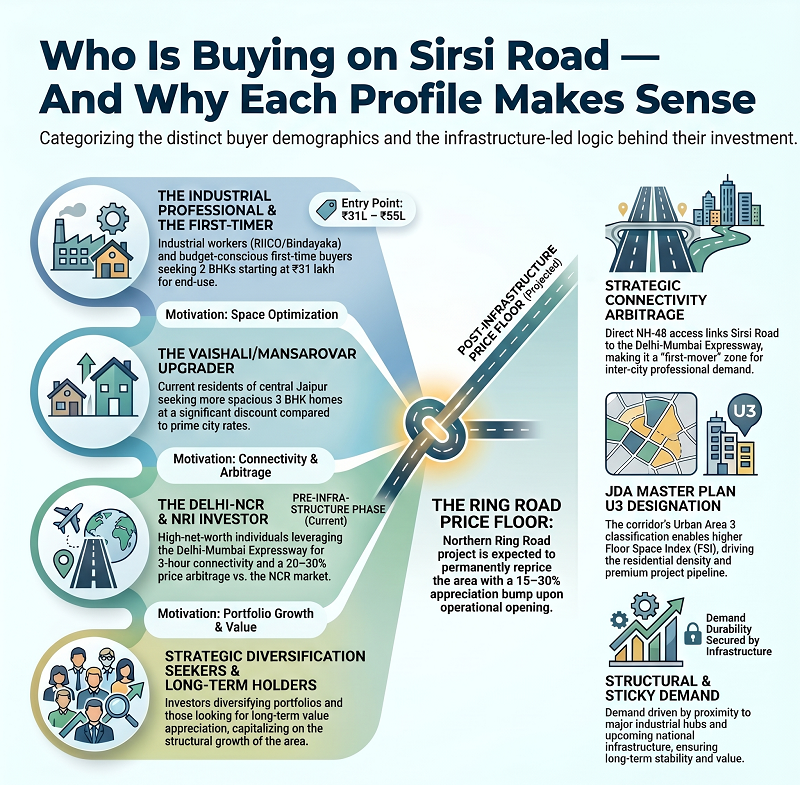
Sirsi Road has five distinct buyer types, each with a different rationale:
The Industrial Professional
Mid-level executives and skilled workers employed at RIICO Industrial Area, Bindayaka, and the surrounding manufacturing belt form the backbone of end-user demand on Sirsi Road. They are buying 2 and 3 BHK apartments in the ₹35–55 lakh range — not as investment vehicles, but as homes. This segment doesn’t disappear when market sentiment shifts. It creates durable rental demand and consistent price support.
The Upgrader from Mansarovar and Vaishali Nagar
A specific and growing segment: families who currently own property in Mansarovar or Vaishali Nagar, have accumulated equity in those assets, and are looking to upgrade to larger homes without paying central Jaipur rates. Sirsi Road lets them buy a 3 BHK for roughly what a 2 BHK costs in their current neighbourhood. They’re not giving up connectivity — they’re gaining space. This segment values quality developers and gated community formats.
The Delhi-NCR Investor
Investors from Gurgaon, Noida, and Delhi who are looking at Jaipur as a second real estate market. Their trigger is usually the Delhi-Mumbai Expressway, the falling friction of Jaipur access, and the price arbitrage: Jaipur’s best corridors are priced at 20–30% of comparable Delhi NCR rates. Sirsi Road specifically attracts this segment because its NH-48 connectivity story is straightforward and easy to underwrite from a distance.
The NRI Buyer
Non-resident Indians evaluating Jaipur as a re-entry point into Indian real estate. Jaipur’s appeal to NRIs is its combination of cultural familiarity, lower base prices, administrative accessibility compared to Mumbai or Bengaluru, and improving infrastructure. The Bandikui-Jaipur Expressway spur makes Jaipur’s connection to national transport networks much more legible. Sirsi Road’s proximity to NH-48 is a clean, simple connectivity story for an NRI who can’t be physically present to manage a complex asset.
The First-Time Buyer Priced Out of Prime Areas
Young professionals and young families who want to own property in Jaipur but find Vaishali Nagar or Mansarovar Extension at a ticket size that doesn’t work for their current income. A 2 BHK on Sirsi Road starts at ₹31 lakh. A comparable 2 BHK in Vaishali Nagar starts at ₹38 lakh and goes up to ₹73 lakh. The quality gap is closing as premium developers begin delivering on Sirsi Road. The price gap remains meaningful. First-time buyers are rational actors. When quality crosses a threshold, they go where value is.
What's Actually Available Right Now — Supply Analysis
There are 350+ properties listed across platforms on Sirsi Road as of mid-2026. The breakdown is approximately: 100+ apartments, 100+ residential plots, 5+ builder floors, and the balance in villas and independent houses. Active projects number 35+ across the pre-launch, under-construction, and ready-to-move spectrum.
Who's Building Here
The developer landscape on Sirsi Road is primarily local and regional builders who have established a track record in western Jaipur. Key names include Manglam Developers (Manglam Grand Residency), Platinum Real Mart LLP (Platinum Amaltas), UDB (Sirsi Villa), and Unnati Infratech. The RERA-registered project pipeline is growing — a recently launched project (JB Prime) received RERA registration RAJ/P/2025/4233, with units ranging from ₹46.65L to ₹98.24L across 1,037–2,183 sq ft configurations.
The Undersupply Problem — And Why It's an Opportunity
Here is what the supply data actually tells you: despite 350+ listings, the proportion of genuinely premium gated community projects with full amenity packages — clubhouse, gym, pool, CCTV, children’s play area, covered parking, 24-hour security — remains low. Most of the supply on Sirsi Road is standard residential construction. The market for a well-specified, design-forward gated community is materially undersupplied relative to the number of upgrader and aspirational buyers now looking at this corridor.
This is not a minor gap. In Jaipur’s mature corridors like Vaishali Nagar, premium gated projects command a 15–25% price premium over standard apartments. On Sirsi Road, that premium hasn’t been established yet — because the premium product hasn’t arrived at scale yet. The developer who delivers it first sets the benchmark.
What It's Actually Like to Live Here — Liveability Index
Any honest guide to Sirsi Road has to cover what the area is like to live in today — not what it will be like when all the infrastructure arrives. Buyers make decisions based on current reality, not future projections alone.
The Positives — What Residents Consistently Report
- Less traffic congestion than central Jaipur — daily commute quality is meaningfully better than Tonk Road or Ajmer Road corridors
- Larger plot sizes and more open space per sq km compared to Mansarovar or Vaishali Nagar at equivalent price points
- Good cab and auto availability — connectivity to public transport infrastructure is rated 4.1/5
- Safety perception is strong — 4.2/5 resident rating — with police presence and gated community culture growing
- Retail accessibility: Capital Galleria Mall, SP Tower, Park Square within daily use distance
- Sports infrastructure: Narayana Sports Academy, Surajmal Cricket Ground, and Balaji Academy are within 5 km
The Honest Gaps — What Still Needs Work
- Water supply: A significant portion of Sirsi Road relies on private tankers. Municipal water supply is irregular. This is a genuine quality-of-life issue for residents today and is expected to improve as the area urbanises under JDA master plan development
- Internal roads: Some colonies have broken and under-maintained internal roads. Main arterial road quality is better than internal colony roads
- Drainage: Waterlogging during monsoon season is reported in some sub-areas — a common issue across Jaipur’s rapidly developing western belt
- Streetlights: Gaps in streetlight coverage on internal roads — being addressed as development density increases
- Pollution: RIICO proximity means some industrial activity. Air quality is a point of concern for some residents, though it is significantly better than central Jaipur’s congestion-driven pollution
The pattern here is consistent with every corridor that has subsequently matured in Jaipur: these are infrastructure gaps in a rapidly developing area, not structural deficiencies. They are the same complaints that residents of Vaishali Nagar Extension had 5–7 years ago. The resolution timeline is tied directly to developer activity and JDA investment, both of which are already accelerating on Sirsi Road.
The Rental Market on Sirsi Road — What to Expect as an Investor
Rental yield on Sirsi Road currently runs at approximately 2–3% annually — lower than Jagatpura (4.9%) or Vaishali Nagar Extension (4.8%), which lead Jaipur’s rental yield rankings. This is important context: Sirsi Road is not currently a strong cash-flow corridor. It is a capital appreciation corridor with improving rental dynamics.
Here are the current rental market numbers:
| Configuration | Monthly Rent Range | Buy Price Range |
|---|---|---|
| 2 BHK (850–1100 sq ft) | ₹9,700 – ₹13,500/mo | ₹30.7L – ₹48.3L |
| 3 BHK (1200–1600 sq ft) | ₹13,500 – ₹18,000/mo | ₹49L – ₹67L |
| 4 BHK (1800–2400 sq ft) | ₹18,000 – ₹26,000/mo | ₹75L – ₹1.1 Cr |
Rental demand is driven primarily by RIICO Industrial Area workers, mid-level corporate professionals, and families relocating to Jaipur from smaller Rajasthani towns for educational or professional access. The vacancy rate is moderate rather than low — which is consistent with a corridor that is still building its tenant base alongside its residential supply.
For a buy-to-let investor, Sirsi Road makes most sense as a hybrid strategy: the rental income covers a portion of the holding cost while capital appreciation builds equity. It is not the right corridor if your primary need is maximum rental yield from day one. It is the right corridor if you have a 5–7 year horizon and want to capture the bulk of the corridor’s appreciation curve.
Comparative context: When Jagatpura had a rental yield of 2–3% approximately 7–8 years ago, its flat appreciation over the following 5 years outpaced corridors with higher yields at that time. The yield-vs-appreciation trade-off consistently favours early-cycle corridors for total return investors with a medium-term horizon.
The Legal Landscape — What to Check Before You Buy on Sirsi Road
Most real estate content avoids this section entirely. We think that’s a mistake. A buyer who understands the regulatory landscape makes better decisions and is less likely to get burned. So here’s what you need to know specifically about Sirsi Road from a legal and regulatory standpoint.
JDA vs Nagar Nigam Jurisdiction
Sirsi Road falls under JDA (Jaipur Development Authority) jurisdiction for planning and development approvals. Properties here fall under JDA-approved sector plans — specifically Sectors 3, 13–14, and 48–49. When evaluating any project, the first question to ask is: is this development JDA-approved, or is it in a category of land (agricultural conversion, Nagar Nigam boundary) that may carry higher title risk? Always ask for the JDA-approved layout plan and the relevant sector plan designation before proceeding.
RERA Verification — Non-Negotiable
Rajasthan RERA (Real Estate Regulatory Authority) registration is mandatory for any residential project above a threshold size. You can verify any project at the Rajasthan RERA portal (rera.rajasthan.gov.in). A RERA number means: the developer has disclosed the project details under oath, the escrow account requirement is in effect (70% of collections must go into a ring-fenced account for construction), and buyers have legal recourse for delays.
Never book a flat on Sirsi Road — or anywhere in Jaipur — without first verifying RERA registration. Some developers try to collect ‘expressions of interest’ or ‘soft bookings’ before RERA registration. This is legally ambiguous and leaves buyers exposed. A legitimate developer will have RERA registration before accepting any booking amount.
Title Due Diligence
For plots and land on Sirsi Road specifically, verify the following before transacting: the khasra number and jamabandi (land records), current land use designation in the JDA master plan, any agricultural conversion status (abadi to residential), and whether there are any encumbrances or court disputes on the title. A competent property lawyer in Jaipur can do a full title search for ₹8,000–15,000 — an expenditure that is trivially small relative to the transaction value.
Common Pitfalls on This Corridor
- Buying in a society without JDA-approved layout — leads to problems with possession and utility connections
- Accepting ‘booking receipts’ before RERA registration — no legal protection
- Overlooking water supply situation for specific colonies — affects both liveability and resale value
- Not checking carpet area vs super built-up area ratio — some projects on Sirsi Road have high loading factors (30%+)
- Ignoring possession clause and delay penalty terms in the builder-buyer agreement
10. Sirsi Road vs The Competition — Full Corridor Comparison
This is the table you came here for. Use it to stress-test whether Sirsi Road belongs in your shortlist, or whether a different corridor serves your specific objective better.
| Parameter | Sirsi Road | Ajmer Road | Tonk Road | Vaishali Nagar | Jagatpura |
|---|---|---|---|---|---|
| Avg. flat rate (₹/sq ft) | ₹4,200 | ₹4,200 | ₹4,500 | ₹4,950–5,350 | ₹4,800+ |
| 5-year flat appreciation | 64.7% | 71.4% | ~45% | 41.4% | ~55% |
| 3-year land appreciation | 85.7% | ~40% | ~30% | ~25% | ~50% |
| 1-year flat appreciation | 2.4% | 20.0% | Stable | 3.1–12.6% | ~6% |
| NH-48 / Expressway access | Direct (3 km) | Indirect | No | Direct | No |
| Ring Road impact zone | Yes (Northern) | Yes (Northern) | Yes (Southern) | Yes | Yes (Southern) |
| RIICO Industrial Area | 3 km | Distant | Distant | 5–8 km | Distant |
| Airport distance | ~20 km | ~22 km | ~15 km | ~13 km | ~8 km |
| Metro connectivity | Not yet | Planned Phase 2 | Limited | Pink Line (planned) | Planned |
| Entry ticket (2BHK) | ₹31–48L | ₹25–46L | ₹27–47L | ₹38–73L | ₹35–55L |
| Rental yield | ~2–3% | ~3% | ~3% | ~5% | ~4.9% |
| Maturity stage | Early growth | Mid growth | Mature | Mature | Mid growth |
Reading the table: Sirsi Road wins on entry price, land appreciation trajectory, and NH-48 access. It trails on current rental yield, metro connectivity, and maturity of social infrastructure. For an investor with a 5+ year horizon, the entry price and appreciation trajectory are the dominant variables. For an end-user who needs everything fully developed today, Vaishali Nagar or Jagatpura may suit better at a higher entry cost.
Where Is Sirsi Road Headed — Honest 5-Year Outlook
Let’s be direct about what we know and what we’re inferring.
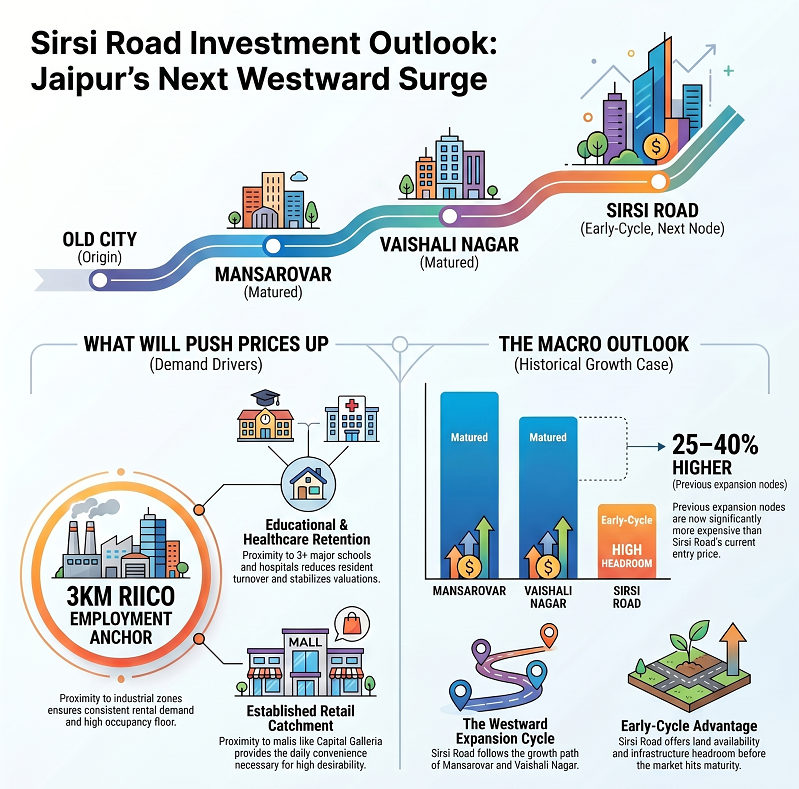
What Will Push Prices Up
- Northern Ring Road operational completion (likely within 3–4 years): historically, this triggers a 15–30% price jump in the direct influence zone — Sirsi Road is in that zone
- Delhi-Mumbai Expressway full operationalization: increases Jaipur’s NRI and NCR investor interest; western NH-48 corridors are the primary beneficiary
- Premium developer entry: as more quality developers enter the corridor, the average price floor rises and the perception of the area shifts from ‘affordable’ to ‘premium value’
- RIICO expansion and employment growth: more industrial and logistics activity in the 3 km radius directly increases rental demand and end-user purchase intent
- JDA master plan development: as the Sector 48–49 zone develops under the master plan framework, plot values especially will continue their strong trajectory
What Could Slow Things Down
- Ring Road delays: NHAI land acquisition across 200 villages is a complex process with a track record of delays in India — a 12–24 month delay is plausible and would push the price catalyst timeline out
- Metro non-inclusion: if metro Phase 2 plans do not extend to the Sirsi Road belt, the corridor will miss a connectivity upgrade that Ajmer Road and Vaishali Nagar belt will benefit from
- Infrastructure gap persistence: if water supply, internal roads, and drainage improvements don’t accelerate with developer activity, end-user demand may remain softer than the investment case implies
- Oversupply risk: 35+ active projects is not yet an oversupply situation, but if developer activity doubles in the next 2 years without commensurate demand growth, absorption rates could slow
The Base Case
Based on the data available as of May 2026: Sirsi Road flat prices are likely to reach ₹5,800–6,500/sq ft within 5 years, implying 38–55% appreciation from current levels, driven primarily by the ring road completion and premium developer entry. Land appreciation is likely to continue outpacing flat appreciation. This is consistent with what happened in Vaishali Nagar Extension and Jagatpura at comparable stages of their development cycle.
The range of outcomes is wide — this is an emerging corridor, not a mature one. But the risk-reward ratio at ₹4,200/sq ft entry price, with three infrastructure catalysts in the pipeline, compares favourably to buying into corridors that are already pricing in their infrastructure premium.
Frequently Asked Questions
Q: Is Sirsi Road good for investment in Jaipur?
A: Yes — specifically for investors with a 5–7 year horizon who are looking for capital appreciation rather than immediate rental yield. The data is clear: land has appreciated 129.4% in 10 years and 85.7% in the last 3 years. With three major infrastructure projects (Northern Ring Road, Delhi-Mumbai Expressway, JDA Master Plan development) converging on the corridor, the conditions for the next phase of appreciation are in place. The entry price at ₹4,200/sq ft for flats and ₹3,100–5,100/sq ft for land remains significantly below comparable western Jaipur corridors.
Q: What is the property rate on Sirsi Road Jaipur?
A: As of 2026, the average flat rate is ₹4,200/sq ft. The range for flats is ₹4,050–5,200/sq ft. Land rates run ₹3,100–5,100/sq ft with an average of approximately ₹3,900/sq ft. A 2 BHK flat is available in the range of ₹30.7L–₹48.3L. A 3 BHK runs ₹49L–₹67L. A 1,000 sq ft residential plot averages approximately ₹33.5L.
Q: Is Sirsi Road connected to the Jaipur Ring Road?
A: Yes — Sirsi Road falls within the influence zone of the Northern Jaipur Ring Road, a ₹6,500 crore NHAI project that runs 99.35 km from Chitroli (Ajmer Road) to Bassi (Agra Road), bypassing northern Jaipur. NHAI has begun land measurement and field surveys. The ring road is expected to materially improve connectivity from the Sirsi Road corridor to the Delhi Highway and other national road networks, and historically such projects lift property prices in the influence zone by 15–30%.
Q: Which projects are coming on Sirsi Road Jaipur?
A: As of mid-2026, there are 35+ active residential projects on the corridor ranging from plotted development to gated apartment complexes. Notable existing projects include Shyamashish Sinwar City, Joy Royal Greens, Anandam Heights IV, Lamba Heights 3, JB Prime (RERA registered RAJ/P/2025/4233), Platinum Amaltas, and UDB Sirsi Villa. New launches are expected as the ring road infrastructure progress draws more developers to the corridor. RERA registration is the key indicator to watch for legitimate upcoming launches.
Q: Should I buy a plot or a flat on Sirsi Road?
A: The appreciation data gives a clear answer: land has significantly outperformed flats over every time horizon measured — 85.7% vs 40% over 3 years, and 129.4% vs 42.4% over 10 years. If capital appreciation is the primary objective and you have a medium-to-long term horizon, plots have historically delivered higher returns. If end-use, rental income, or lower management complexity is the priority, a RERA-registered apartment in a gated society is the more practical choice.
Q: Is it safe to buy a pre-launch property on Sirsi Road?
A: Only if the project has RERA registration. Under Rajasthan RERA rules, a developer cannot legally accept a booking amount for a project without RERA registration. If you encounter a 'pre-launch offer' before RERA registration, it is legally unprotected. Once RERA-registered, buyers benefit from escrow account protections, disclosure requirements, and legal recourse for delays. The RERA registration number can be verified at rera.rajasthan.gov.in before signing anything.
Q: How far is Sirsi Road from Vaishali Nagar?
A: Approximately 4–5 km. Sirsi Road is the next logical residential corridor west and northwest of Vaishali Nagar. The two areas are functionally adjacent, sharing some social infrastructure while offering a significant price difference. This adjacency is a key part of the corridor's investment case: buyers who cannot afford Vaishali Nagar at ₹4,950–5,350/sq ft find comparable lifestyle potential on Sirsi Road at ₹4,200/sq ft.
Q: Is Sirsi Road connected to NH-48?
A: Yes — NH-48 (the Delhi-Mumbai Expressway national highway corridor) is approximately 3 km from Sirsi Road. The corridor is also connected via NH-52 (Jodhpur-Jaipur National Highway). This gives Sirsi Road residents direct access to the national expressway network, including the Bandikui-Jaipur spur (operational as of 2025) that connects Jaipur to the Delhi-Mumbai Expressway. This is a connectivity advantage that most mid-range Jaipur corridors do not have.
Q: What is the rental yield on Sirsi Road?
A: Currently approximately 2–3% annually, which is lower than Jagatpura (4.9%) and Vaishali Nagar Extension (4.8%), the highest-yield areas in Jaipur. Monthly rents for a 2 BHK run ₹9,700–₹13,500 and for a 3 BHK ₹13,500–₹18,000. Sirsi Road is a capital appreciation corridor, not a cash flow corridor. The investment case is based on holding cost management via partial rental coverage while the primary return is generated by price appreciation.
Q: Who are the main developers on Sirsi Road?
A: The corridor's developer landscape includes Manglam Developers, Platinum Real Mart LLP, UDB, Unnati Infratech, and several other regional builders with track records in western Jaipur. As the corridor appreciates, established national and regional developers are increasingly evaluating land parcels here. The entry of premium developers is itself a price catalyst — it signals market confidence and attracts a different segment of buyer.
Q: How does Sirsi Road compare to Ajmer Road for investment?
A: Both corridors currently average ₹4,200/sq ft for flats. Ajmer Road has appreciated 71.4% over 5 years versus Sirsi Road's 64.7%. The key difference is stage of cycle: Ajmer Road is more developed, has more social infrastructure, but less price headroom. Sirsi Road is earlier-cycle with better NH-48 connectivity and ring road impact potential. For a buyer entering today, Sirsi Road offers more upside at equivalent entry cost, with the trade-off of less developed social infrastructure currently.
Q: What are the risks of buying on Sirsi Road today?
A: The honest risks are: infrastructure gap persistence (water supply, internal roads), ring road delay risk, absence of metro connectivity on current plans, moderate rental yield for cash flow investors, and patchy internal road quality in some micro-pockets. These are risks of an early-cycle corridor. None of them are permanent structural deficiencies. All of them were present in Vaishali Nagar Extension 5–7 years ago before it became one of Jaipur's highest-appreciation areas. The risk-reward calculus depends on your investment horizon and tolerance for holding an asset through its development cycle.
Unlock Early Access
Something extraordinary is coming on Sirsi Road, Jaipur. Join the priority list to get floor plans and pre-launch pricing before the public reveal.
